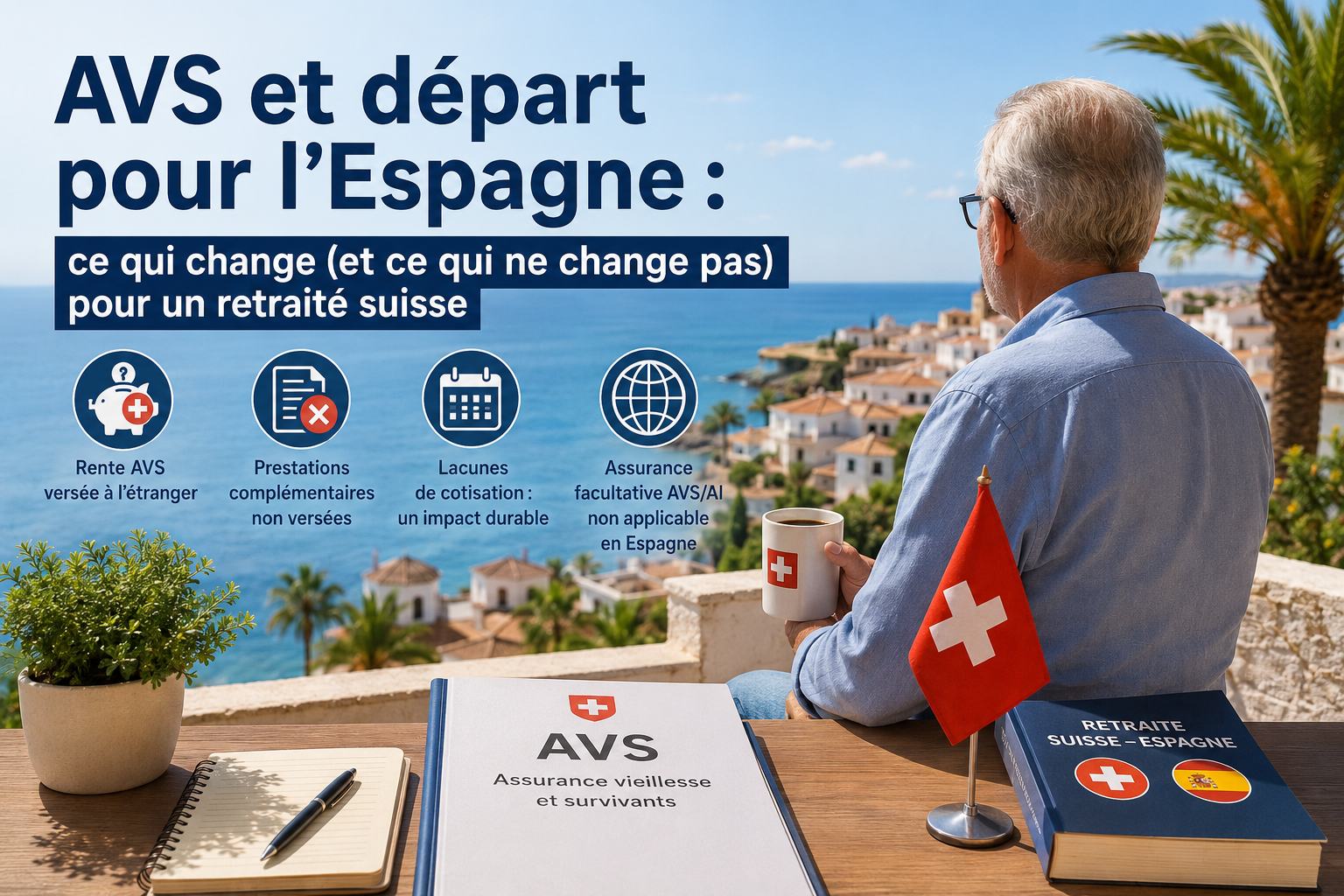
Leaving Switzerland to settle in Spain is often presented as an attractive life project: climate, quality of life, real estate, retirement, proximity to the sea.
But before leaving, many Swiss residents ask themselves the same practical questions: what happens to health insurance? How does the Swiss second pillar work? From when does someone become a Spanish tax resident? Which documents are required in Spain? And above all: in what order should the procedures be completed?
These concerns are normal. Moving to another country is not only about housing. It also affects taxation, healthcare, insurance, administrative procedures, bank accounts, vehicles, retirement and sometimes family matters.
This is precisely why a Strategic Audit Switzerland → Spain can be useful before making a final decision. It provides an overall view of the situation, identifies sensitive points and gives a concrete idea of what awaits the person before, during and after the move.
The fear of making an administrative mistake
Many people think that finding a property in Spain, signing a purchase deed or renting an apartment is enough for the project to be ready.
In reality, settling in Spain involves several administrative procedures that must be coordinated. Some are completed in Switzerland before departure. Others are carried out in Spain once accommodation has been found or the relocation process has begun.
The procedures often involved include:
- declaring the departure to the Swiss municipality;
- clarifying health insurance coverage;
- tax residency issues in Switzerland and Spain;
- obtaining or using the NIE;
- empadronamiento with the Spanish municipality;
- registration certificate as a resident in Spain;
- opening or adapting bank accounts;
- management of a Swiss vehicle;
- private or public insurance;
- documents required for retirement, healthcare or taxation.
The issue is not only knowing which procedures exist. The real challenge is understanding which ones apply to your situation and in which order they should be completed.
The NIE: an essential number, but not enough
The NIE, or foreigner identification number, is often one of the first documents mentioned when a Swiss citizen prepares a project in Spain.
It is required in many situations: real estate purchase, tax procedures, banking, notary matters, contracts or dealings with the Spanish administration.
However, having an NIE does not automatically mean that the person is properly settled in Spain. It is an administrative identification number. It does not by itself resolve residency, taxation, healthcare or all obligations linked to a long-term installation.
This is a common misunderstanding. Some people obtain an NIE to purchase property and then believe their administrative situation is complete. In reality, other procedures may still be required in order to genuinely live in Spain.
The green residence certificate: a key document for living in Spain
Swiss citizens benefit from a specific framework allowing them to settle in Spain, but any stay of more than three months generally requires formal registration with the Spanish authorities.
The document commonly referred to as the “green NIE card” is actually the registration certificate as an EU citizen or equivalent. It confirms registration in the Spanish foreigners’ register for people residing in Spain beyond a certain period.
This document is often essential to stabilize the administrative situation in Spain. It may be required for many practical procedures: healthcare, banking, taxation, municipal registration, insurance, vehicles or dealings with certain administrations.
Again, it should not be treated as an isolated formality. It must be integrated into an overall relocation strategy.
Empadronamiento: municipal registration in Spain
Empadronamiento corresponds to registration with the Spanish municipality of residence.
This procedure may appear simple, but it often has important practical consequences. It proves a local address and may be required for certain administrative, healthcare, tax or social procedures.
For a Swiss citizen leaving Switzerland to settle in Spain, empadronamiento must be planned with the right timing. It is not simply a matter of “registering at the town hall”, but understanding how this registration interacts with the departure from Switzerland, tax residency, health insurance and other Spanish documents.
Health insurance: the fear of losing coverage
One of the biggest concerns relates to healthcare.
Many Swiss residents wonder whether they will be able to keep their Swiss health insurance, whether they will need insurance in Spain, whether they will have access to the Spanish public healthcare system or whether they will need private insurance.
The answer depends heavily on the personal situation: retiree, employee, self-employed person, annuitant, cross-border worker, person receiving a Swiss pension, spouse, family or someone still partially connected to Switzerland.
In certain situations, the S1 form may play an important role. It is used to recognize entitlement to healthcare assistance in another country according to applicable coordination rules. It should not be confused with the S2 form, which mainly concerns planned medical treatment in another country.
This is not an area where improvisation is advisable. A poor understanding of health insurance coverage can create serious problems once settled in Spain.
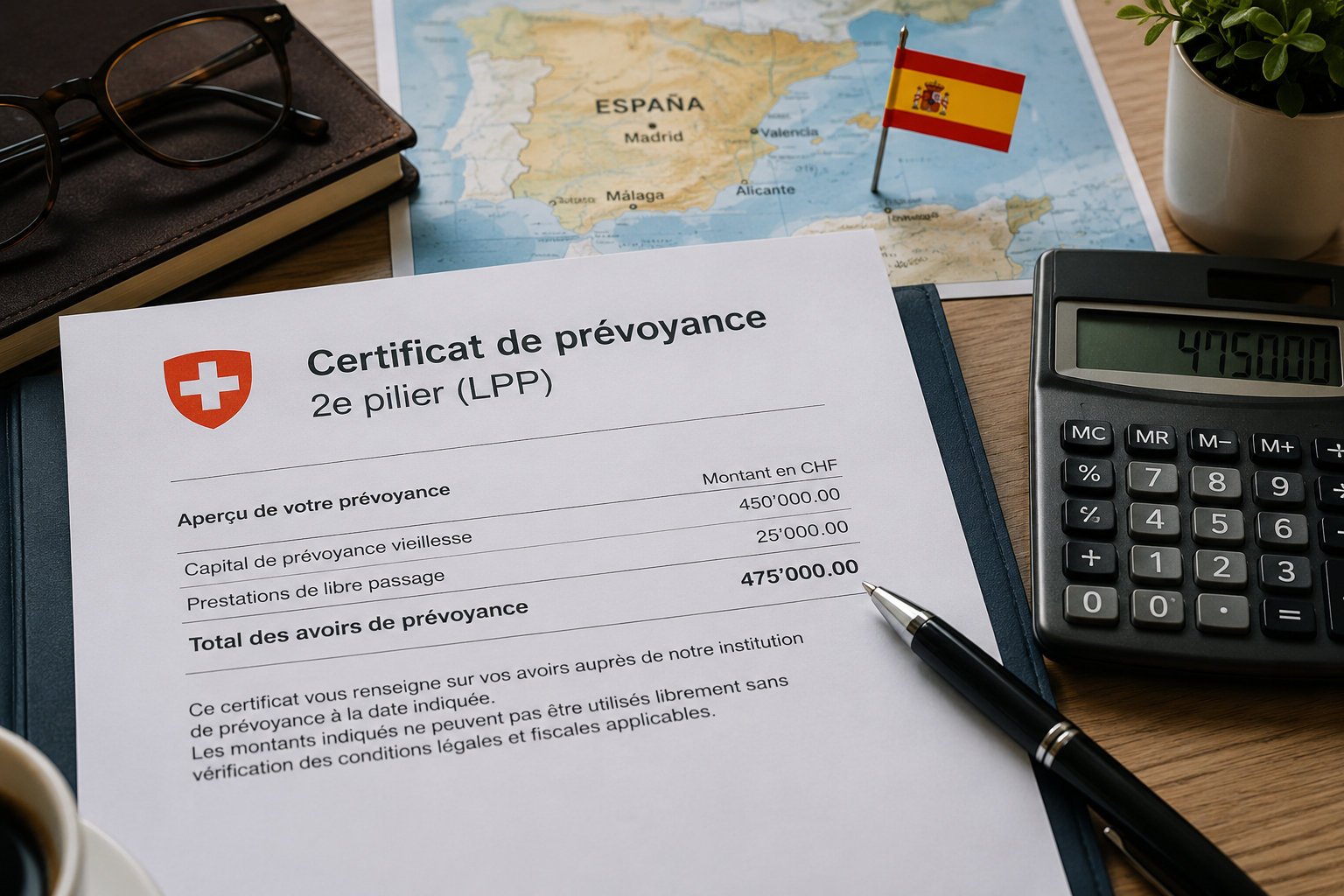
Second pillar, occupational pension and taxation: a major concern
For many Swiss citizens, the question of the second pillar is central.
Some wish to use their occupational pension to purchase property in Spain. Others want to understand what happens in the event of a permanent departure from Switzerland, retirement, capital withdrawal or change of tax residency.
The questions are often the same:
- can I withdraw my second pillar if I leave Switzerland?
- is the withdrawal taxed in Switzerland?
- can Spain also tax certain amounts?
- what does the tax treaty between Switzerland and Spain provide?
- is the situation different if I am already a Spanish tax resident?
- when should the decision be made?
These are sensitive issues, because poor timing can have significant tax consequences.
A Strategic Audit Switzerland → Spain helps ask the right questions before taking action, clarify the risks and prepare discussions with tax specialists or relevant institutions.
Tax residency: Switzerland or Spain?
Tax residency is one of the most misunderstood topics.
Many people believe that tax residency depends only on where they want to live. In reality, it depends on several factors: duration of stay, centre of personal and economic interests, housing, family, income, actual organization of daily life and the criteria provided by applicable tax rules.
The tax treaty between Switzerland and Spain helps avoid certain situations of double taxation, but it does not mean there are no tax consequences when leaving Switzerland.
Before leaving Switzerland, it is therefore important to understand from when Spain could consider the person a Spanish tax resident and what consequences this may have on income, wealth, retirement, second pillar withdrawals or reporting obligations.
The Swiss vehicle: an often underestimated issue
The vehicle is often forgotten in the initial planning.
However, a vehicle registered in Switzerland cannot always remain indefinitely in Spain under any conditions. Questions relating to insurance, importation, registration, technical inspection, taxes and driving licences must be anticipated.
This issue becomes even more important when the person keeps ties with Switzerland, regularly travels between the two countries or is still uncertain whether the move to Spain will be permanent.
Bank accounts and payments
A move to Spain also raises very practical banking questions.
Should a Swiss bank account be kept? Should a Spanish account be opened? How should charges, taxes, insurance, condominium fees or local service providers be paid?
These questions may seem secondary at first, but they quickly become concrete after the purchase or relocation. It is therefore preferable to anticipate them rather than deal with them in an emergency.
The certificado digital: a very useful tool in Spain
Once settled in Spain, many procedures are carried out online with the administration.
The certificado digital allows access to various Spanish administrative services, the signing of certain procedures and the management of online formalities.
For someone arriving from Switzerland, this system may be surprising. In Spain, a large part of the relationship with the administration relies on digital tools, identifiers, online platforms and electronic notifications.
This is one of the elements many people discover too late.
The fear of losing control of the project
The real issue is not only administrative. It is also psychological.
Many Swiss residents are used to a structured, predictable and relatively clear system. In Spain, procedures can be more fragmented, involve several administrations, vary according to the region or require different documents depending on the case.
This difference often creates a feeling of losing control.
Questions then arise one after another: who should be contacted? Which document should be requested? Which procedure should be completed first? What must be done before leaving Switzerland? What can be done after arriving in Spain?
This is precisely the stage where structured support can prevent mistakes, omissions or decisions taken too quickly.
Why request an audit before leaving Switzerland?
The Strategic Audit Switzerland → Spain is not intended to sell a ready-made solution.
Its purpose is to provide a clear and realistic view of the situation before making an important decision.
It notably allows people to:
- review their current situation in Switzerland;
- identify the possible consequences of leaving;
- clarify the procedures to be planned in Spain;
- identify sensitive tax matters;
- anticipate questions relating to the second pillar, retirement or healthcare;
- understand useful or necessary Spanish documents;
- obtain an initial structured overview of the project;
- make decisions with greater visibility.
The audit does not replace a tax advisor, lawyer, pension fund or health insurance provider. However, it helps structure the questions, prepare discussions with the appropriate professionals and avoid discovering problems once the relocation process is already underway.
A clearer decision before committing
Leaving Switzerland for Spain can be an excellent project, but it must be prepared seriously.
Concerns relating to taxation, healthcare, the second pillar, the NIE, empadronamiento, the green residence certificate, vehicles or Spanish administrative documents should not be ignored.
On the contrary, these issues should be clarified before departure.
A well-prepared project allows people to make decisions more calmly, avoid contradictory procedures and better understand what truly awaits them once in Spain.
For Swiss citizens considering relocation, retirement or a real estate purchase in Spain, the Strategic Audit Switzerland → Spain represents a useful first step to transform concerns into a concrete action plan.
Are you preparing to move from Switzerland to Spain?
The Strategic Audit Switzerland → Spain helps analyse your situation before making a decision: taxation, second pillar, health insurance, Spanish documents, tax residency and procedures to anticipate.
Strategic Audit Switzerland → Spain
Before moving to Spain, certain decisions may have significant tax and administrative consequences.
The strategic audit notably allows the analysis of:
- Swiss / Spanish tax residency;
- the second pillar and pension withdrawals;
- health insurance and the S1 form;
- Spanish administrative procedures;
- double taxation risks;
- the optimal departure timeline.
As every situation is different, the objective is to obtain a clear overview before making important decisions.
View the Strategic Audit Switzerland → Spain
Related articles

 DE
DE  ES
ES  FR
FR  EN
EN